I’m sure most of you have heard about, if not seen, the new Dietary Guidelines for Americans (DGAs) that were released last week.
I could go on and on about how and why “eat real food” is incredibly problematic messaging (and in fact over the years, I have tackled this in various ways on different platforms), but Jess Steier’s newsletter that dropped into my inbox the other morning had a paragraph in it that really hit the nail on the head for me:
“Telling people to “eat real food” without addressing any of [the underlying systemic issues such as affordability, availability, time, energy, among many others] isn’t guidance. It’s judgment and guilt-mongering. It places the burden of fixing a broken food system entirely on individuals who are already navigating impossible constraints.”1
While I don’t co-sign all the ways that she talks about food in that post (for instance, I don’t believe in ‘good’ eating days or ‘bad’ eating days), I think a lot of what she says, including the passage I shared above, is important to hear and understand.
She also touches on the impact this will have on federal programs like SNAP, WIC and school lunch (which are usually shaped by each new set of DGAs), the hypocritical/conflicting messages from this administration between what’s being said about health in our country vs. the messaging this relays, and all those completely (purposefully?) unrepresented in this new set of guidelines.
She also links to Kevin Klatt’s post on this topic, which is at times nutrition science heavy, but worth a read if you’re able to parse some of the more daunting lines and grasp the points he makes about the broader scientific failures he sees with this roll out.
Importantly, he points out the mathematical impossibility to adhere to these new guidelines given the food recommendations they make in conjunction with keeping certain caps from previous DGAs in place (“The DGA recommendation is clearly endorsing high animal fat intakes, which will result in high saturated fat intakes, but confusingly retains the former caps on SatFat at 10% of kilocalories – the 2 struggle to coexist.”2).
As Jess states in her newsletter, “If implementation is impossible, then the guidelines aren’t really meant to govern. They’re meant to [send a] message.”1
And so, we have to ask ourselves, what exactly is that message?
When you click into their shiny new website (I did, so you don’t have to), we’re immediately given, in bold face type, “Real Food Starts Here” and told that health starts on our plate, not in our medicine cabinet. This invokes the oft-repeated phrase by wellness culture that “food is medicine.” If you just eat the ‘right’ way, you’ll be able to cure all your chronic ailments – something that nearly anyone who struggles with chronic conditions can attest, is not the case. They even use the wellness keywords of ‘whole,’ ‘nutrient-dense’ and ‘natural‘ to invoke the purity messaging diet and wellness culture thrive on.
This is then followed by imagery of all white farmers, ranchers, fishermen and children serving freshly picked vegetables from their farms and cooking over an open fire. A fantasy they’re trying to sell? Maybe to a certain swath of people. The fact is, this is simply not the reality (or even the fantasy) for the majority of Americans. So then we need to question, who is this messaging actually for?
They follow this up with another bold face statement that “America is sick. The data is clear” whereby they showcase a bunch of disease statistics that aren’t clearly tied to any references.
They go on to showcase a 1992 Food Pyramid showcasing foods such as grains, fruits, vegetables, proteins, dairy and fats under which they demonize processed foods, blaming them as the reason for rising chronic disease (with again, no obvious references or citations).
“For the first time, we’re calling out the dangers of highly processed foods and rebuilding a broken system from the ground up with gold-standard science and common sense.”
At this point, for the small swatch of Americans who have hung on to get here, they may be thinking, ‘Awesome! They’re recognizing the broken food system and they’re going to present a true way to fix it!’
Then they present…an upside down version of the 1992 pyramid they just criticized. Where, as Kevin Klatt points out in his piece, at a high level, not much has really even changed from the past set of recommendations. He presents a side-by-side chart that essentially shows they’re taken out specific vegetable goals and removed refined grains as an option in the grain group (which are fortified with important vitamins and minerals). Kevin dives deep into the specific changes recommended, so if you’re interested, definitely check out his post.
At this point, you might be wondering, as I was, how does this fix a broken food system? How does this increase access, affordability, eliminate food deserts, decrease the burden of time for those of us who do not have all day to prepare a meal from scratch, let alone grow and harvest food in our backyards and slaughter our own meat?
They sort of tell on themselves with the next slide they showcase, stating “Our nation is finding its footing again, moving past decades of unhealthy eating and rebuilding a food culture rooted in health, science, transparency, and personal responsibility.”
At the end of the day, regardless of what the specifics of this plan are, the way with which they chose to disseminate it are unhelpful and in many ways, harmful. The job of public health policy is to translate research into realistic and feasible solutions for the broader public by creating multiple supportive arms to ensure an environment of success for all.
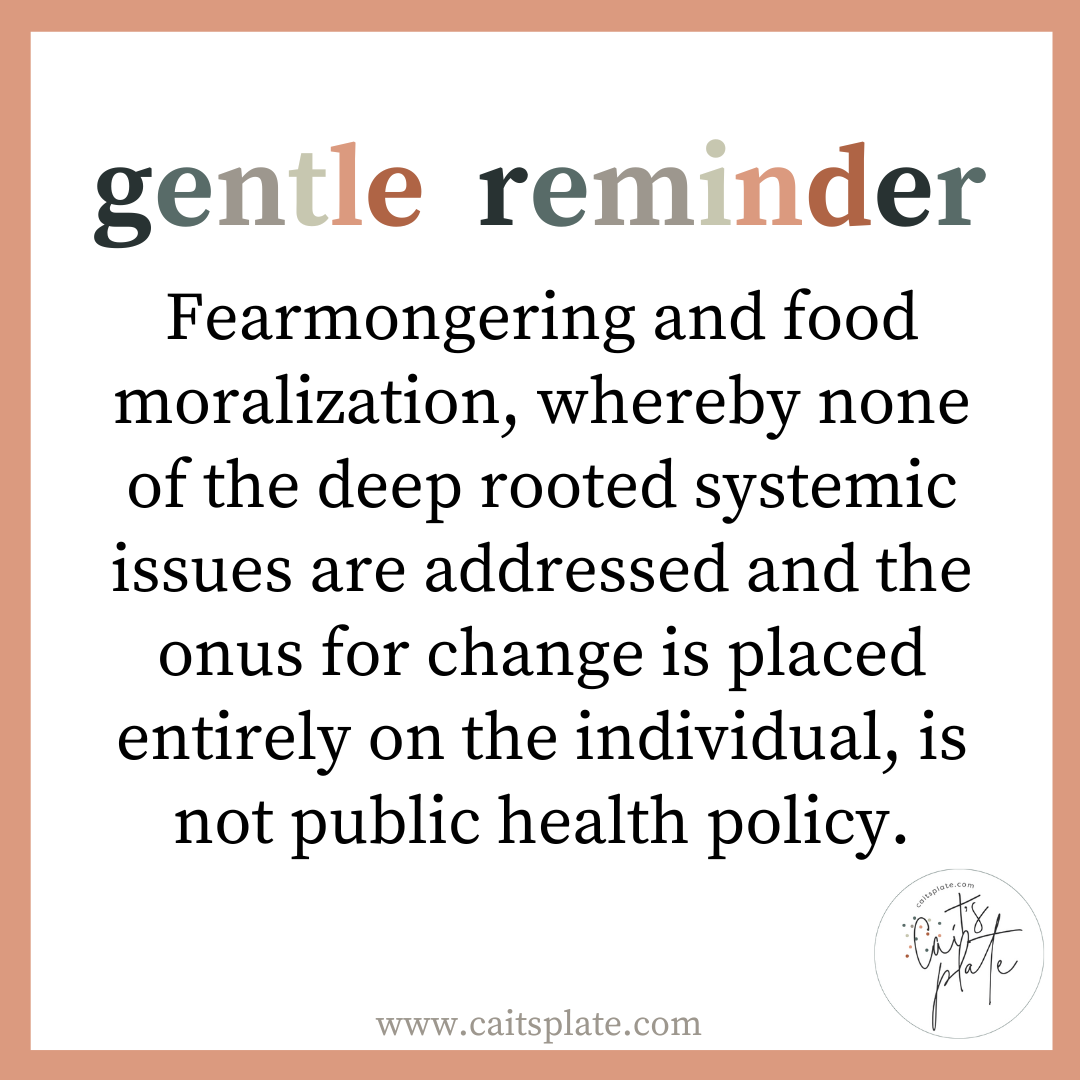
Fearmongering and food moralization, whereby none of the deep rooted systemic issues are addressed and the onus for change is placed entirely on the individual, is not public health policy. It’s right on par with diet culture messaging – promoting a certain goal while refusing to tackle any of the barriers that lay between the individual and achieving those goals, then blaming the individual for the failure. We should demand and deserve better from our public health policies.
References:
- Steier, Jess. Jan 10, 2026. Let Them Eat Real Food. Unbiased Science. https://theunbiasedscipod.substack.com/p/let-them-eat-real-food
- Klatt, Kevin. Jan 8, 2026. Ambiguous DGAs & The Rancher’s Pyramid. KCKlatt’s Substack. https://kcklatt.substack.com/p/ambiguous-dgas-and-the-ranchers-pyramid
Leave a Reply